Sharjah Mosque: Location, Dress Code & Visiting Rules
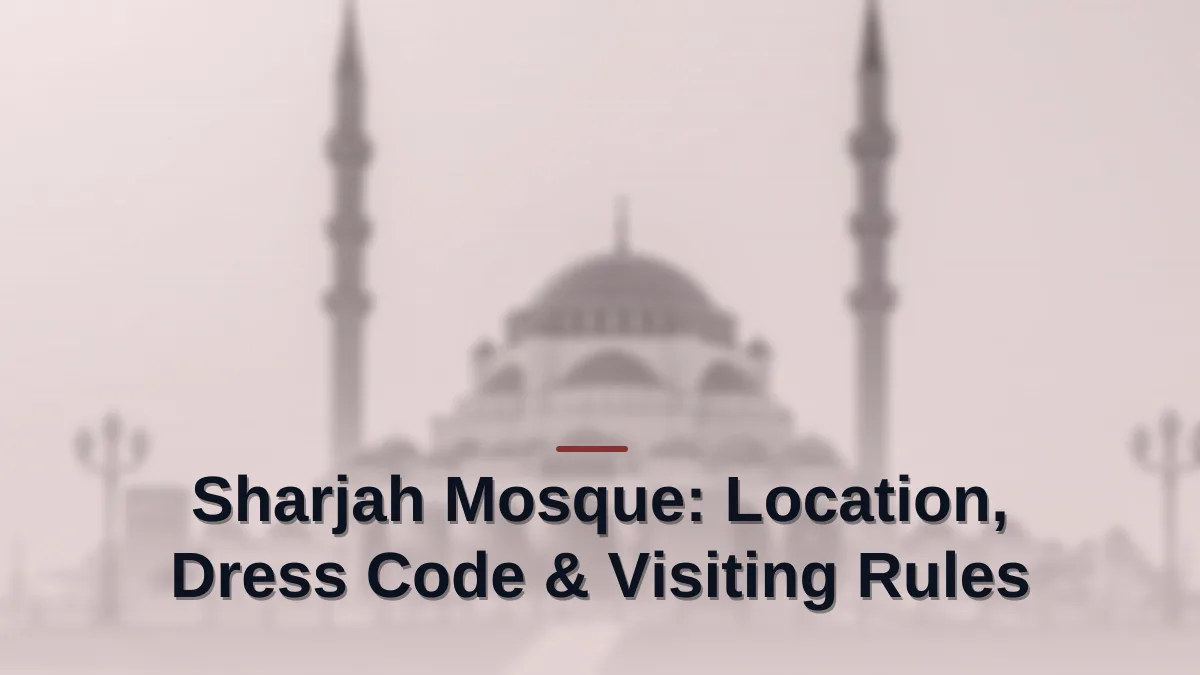
Sharjah Mosque admits non-Muslim visitors free of charge, along dedicated pathways that keep sightseeing apart from worship. It stands in the Tay area, where Emirates Road meets Mleiha Road, and it has been the largest mosque in the emirate since it opened on 10 May 2019.
A visit comes down to three practical points. Dress modestly, come outside prayer times, and plan to arrive by car or taxi.
Sharjah Mosque visitor information

| Detail | Information |
|---|---|
| Area | Tay, at the Emirates Road (E611) and Mleiha Road (E102) junction |
| Opened | 10 May 2019 |
| Entry | Free |
| Non-Muslim visitors | Welcome, on dedicated pathways |
| Capacity | About 25,000 worshippers |
| Site area | 2 million sq ft (185,806 m²) |
| Domes and minarets | 81 domes, two minarets of 75 m |
| Parking | About 2,260 cars and buses |
| Cost to build | AED 300 million |
| Owner | Government of Sharjah |
Location & how to get there
The mosque sits in Tay at the junction of Emirates Road (E611) and Mleiha Road (E102), roughly 35 km from central Dubai. The drive takes 30 to 45 minutes depending on traffic. Drop this map pin for the mosque into your navigation app before you leave.

- Car: the practical choice from both Dubai and Sharjah city, since Emirates Road and Mleiha Road both lead straight to the junction.
- Taxi or ride-hailing: works from Dubai and central Sharjah, and avoids the parking question altogether.
- Public transport: no metro line reaches Tay, so a taxi or your own car is the realistic option.
Parking & entrances
The car park holds about 2,260 cars and buses.
The complex has four public entrances, two women’s entrances, one VIP entrance and one entrance for buses.

Visiting rules for non-Muslims
Non-Muslims can visit free of charge, using the dedicated spaces and pathways, outside the five daily prayers. The mosque is an active place of worship first, so worshippers always have priority over sightseeing.
Dress code
- Men: shoulders and knees covered, which in practice means long trousers and a shirt with sleeves.
- Women: loose clothing that covers arms and legs, and a headscarf over the hair. Scarves are available at the entrance for anyone who arrives without one.
- Everyone: nothing sheer, tight or revealing.
Prayer times & etiquette
The five daily prayers are Fajr, Dhuhr, Asr, Maghrib and Isha, and the daily prayer timetable shifts by a minute or two from one day to the next. Plan the visit between prayers.
Friday midday prayer is the busiest period of the week, so a Friday visit is best kept to the morning or late afternoon. The domes and minarets are lit after dark, which makes the exterior worth seeing in the evening.
Inside, remove your shoes before stepping onto carpeted prayer areas, keep your voice low, and ask before photographing anyone who is praying.
Prayer hall & architecture
The mosque is built in a classical Ottoman style, with two 75 m minarets and 81 domes of different sizes. The main dome is 45 m high with a diameter of 27 m.

The main prayer hall has arched windows with stained glass, verses from the Quran on the walls, a large central chandelier and red carpeting. Seating for worshippers is spread across three areas:
- The main hall, with room for more than 5,000 people, including the 610 women’s places
- The front hall and side lobbies, with room for more than 6,000
- The outer yards, with room for about 13,500
Together that brings the total to roughly 25,000. For ablution, the mosque has two ablution areas with 352 facilities, plus two more outside.
Library, museum & grounds
Beyond the prayer hall, the complex has several spaces that a first-time visitor can walk through:

- A large library of Islamic sciences and Prophetic tradition (Sunnah)
- A museum
- A gift shop and a cafeteria
- An Islamic garden with fountains and waterfalls
- A rubber walking track that runs around the complex
- An area for giving dawah to non-Muslims
- 100 wheelchairs for elderly visitors and people of determination
History & opening
The Ruler of Sharjah, Sheikh Dr Sultan bin Muhammad Al Qasimi, ordered the mosque built in 2014 and followed the construction from its first stages. He inaugurated it on Friday 10 May 2019, after a build that cost AED 300 million.
It replaced King Faisal Mosque, which opened in 1987 with room for more than 16,000 worshippers, as the largest mosque in the emirate. The new site also serves worshippers in Tay and the surrounding suburbs of Al Suyoh, Badea, Hawshi and Juwaiza, along with drivers on Mleiha Road and Emirates Road.
The Central Bank of the UAE marked the opening with two commemorative coins, one gold and one silver. Each weighs 60 g, measures 60 mm across and carries a verse from the Quran.
FAQ
Is Sharjah Mosque open to non-Muslims?
Yes. Non-Muslim visitors are welcome on dedicated pathways, outside prayer times, and must follow the same modest dress code as everyone else.
Is there an entry fee for Sharjah Mosque?
No. Entry is free for worshippers and visitors.
How many people can Sharjah Mosque hold?
About 25,000 worshippers in total: more than 5,000 in the main hall, more than 6,000 in the front hall and side lobbies, and about 13,500 in the outer yards.
Where is Sharjah Mosque?
In the Tay area of Sharjah, at the junction of Emirates Road (E611) and Mleiha Road (E102), about 35 km from central Dubai.
Can I reach Sharjah Mosque by metro?
No. No metro line reaches Tay, so visitors arrive by car, taxi or ride-hailing.
When did Sharjah Mosque open?
On 10 May 2019, inaugurated by the Ruler of Sharjah, Sheikh Dr Sultan bin Muhammad Al Qasimi. Construction began in 2014.
Planning your visit
Set the order of the day around the prayer schedule, since that decides when you can go in.
- Check the prayer times for your date and pick a window between prayers.
- Dress with covered shoulders and knees, and bring a headscarf if you are a woman.
- Drive or book a taxi to the Tay junction, and park in the main car park.
- Walk the garden and the track first, then spend the rest of your time in the library and museum.
- Keep Fridays for the morning or late afternoon.